Swordfish hunt: BlacktipH fishing in the Strait of Messina
The Swordfish hunt in the Strait of Messina is a very unique and old tradition, the origin of which can be tracked in Sicily back to the XVI century.
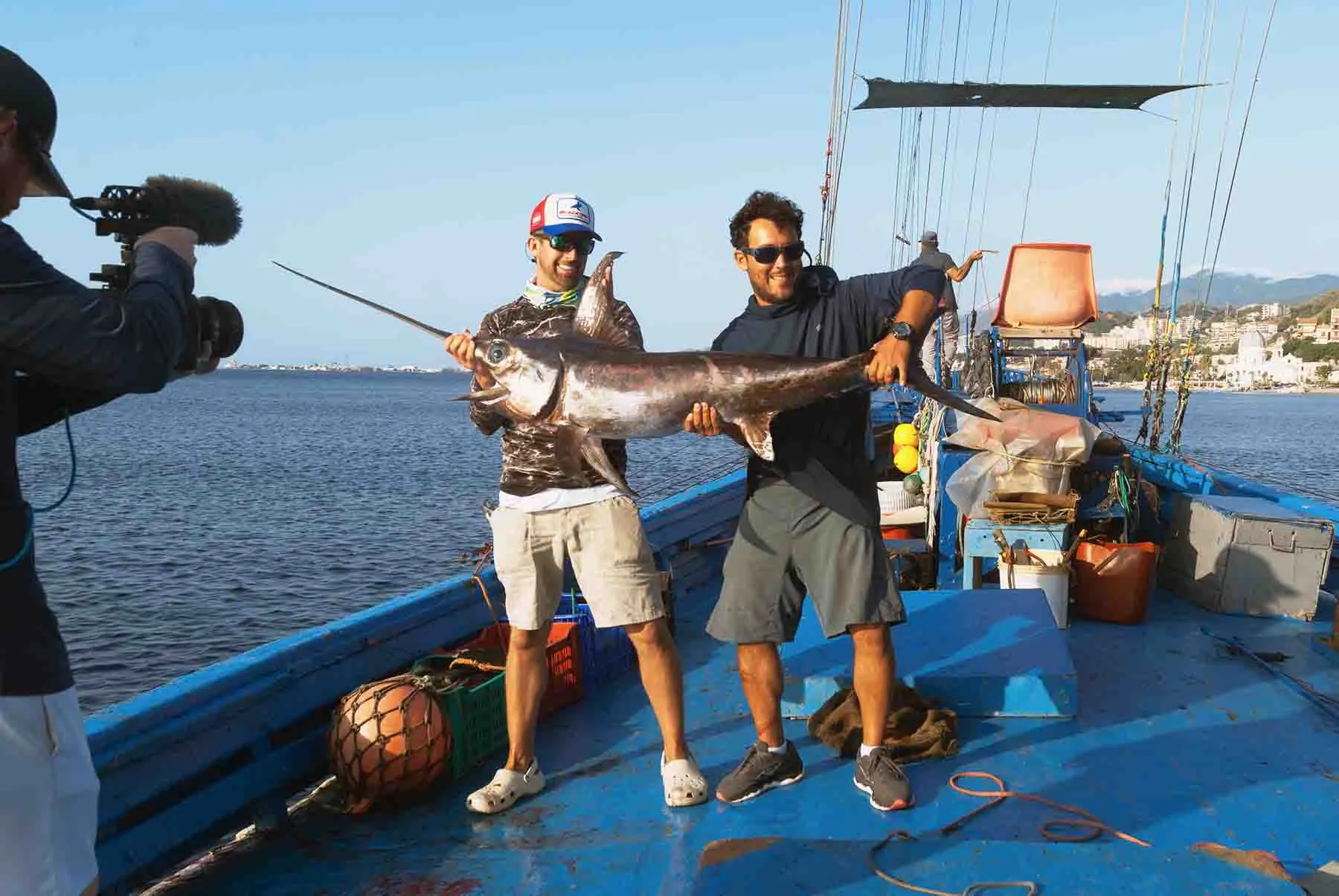
In July 2024 we had the great pleasure to host BlacktipH fishing shooting in the Strait of Messina. Joshua Jorgensen and Davis Bennett came to Sicily to film the traditional hunt made with the use of the harpoon, that has been practiced for thousands of years in the Strait of Messina.

Blacktiph fishing show in Sicily to film the swordfish hunt in the Strait of Messina
BlacktipH fishing show was founded in 2008 and it is now the biggest online platform followed by more than 4 million fishing lovers all over the world.
Founder Joshua Jorgensen reached us back in April, asking to join us in Sicily attracted by the possibility to try himself the swordfish hunt in the Strait of Messina, making a great show about this traditional fishing technique and sharing it with the rest of the world.
Joshua came here to Sicily with Davis Bennett to embark on a lifetime experience, sailing on the feluca boat with his drone and camera, reporting and documenting the traditional activities on the motorboat still used in the Strait of Messina to hunt the swordfish.
For 3 days we filmed on the feluca boat with the swordfish hunters, caught some nice fish, interacting with the swordfish hunters to know more about their life at sea, and also had some spear time to show Joshua and Davis the highlights of the city and the Strait of Messina, and Mt Etna volcano as well.
Watch the film here:
Do you want to experience a once-in-a-lifetime adventure and jump on a feluca boat to try the swordfish hunt? Read on and find out our Swordfish tour in Messina.
Swordfish tour in Messina, Sicily
The swordfish hunt is one of the most memorable experience to try when visiting Messina, Sicily. Whether you are coming via a cruise ship to Messina port, or if you are planning a trip to Sicily, you can customize your fishing experience with us, according to your needs and interests, possibilities and time schedule.
You can easily book here your fishing expedition in the Strait of Messina for 2025. You can choose the amount of time you want to spend on the traditional boats and experience first-hand the working life of swordfish hunters in the Strait of Messina. You will also have the possibility to visit the historic center of Messina and Cape Peloro, the closest point between Sicily and mainland, Italy.
Read on if you want to learn more about the swordfish, the history of this tradition and of the feluca boat.

Difficulties of the swordfish hunters in Messina
The swordfish hunt in the Strait of Messina is a century-old tradition that is carried out with many difficulties, and shared from a generation of fishermen to the next.
It is unfortunately an activity that risks to disappear forever because of the strict regulations that make very challenging for fishermen to continue to work, nowadays. Most of them keep doing this job more because of their family pride, passion and deep affection to the tradition then because of a sufficient economic reward.
If you are interested in learning more about the history of the swordfish hunt in Sicily, the tools and the and how to live yourself this unique experience read on.
Swordfish hunt all over the world and its migration in the Strait of Messina
Besides the Mediterranean Sea, the swordfish is currently caught in the oceans all over the world, such as the Atlantic, the Pacific, the Indian and even in the Baltic Sea and in Australia.
Here in Sicily, in fall and winter time the swordfish likes to stay in the cold and deep waters of the Tyrrhenian Sea, in the Northern coast of Sicily. As spring approaches and the Tyrrhenian water becomes warmer, thus losing density, the swordfish start to move to the colder water of the Sicilian side of the Strait of Messina, in the Ionian Sea. Here they remain throughout the months of June and July, reaching their sexual maturity and mating with a companion that they will follow until they die.

Swordfish Sicily: characteristics and behavior of the “knight” fish
The swordfish is a very particular creature, both in the behavior, as well as in the shape, characterized by a “sword” that is long one third of the total length of the fish.
In the Strait of Messina, it can reach a length of around 10 ft, a weight of 1180 lbs, and a speed of 60 mph, thus being the fastest fish in the Ocean after the black merlin (82mph) and the blue merlin (8mph), that also share with it a very similar shape.
Its body doesn’t have scales but a quite rough skin and its sword can be a very dangerous weapon if the swordfish hunters don’t hit it to death.
This fish is known to have a tenacious and proud temper, always ready to fight for its life when threatened. Many accidents have been documented by swordfish hunters whose harpoons missed the fish. When this happens and the swordfish is merely wounded, it is able to fight with its sword, attacking and piercing the boats and in some cases, even killing fishermen. This happened once in 1947 when a fisherman was pierced and taken down in the deep water by the swordfish.
Those who try the swordfish hunt can experience also the “romantic” attitude of the swordfish, that gives it the epithet of “knight fish”. The swordfish, unlike other fish that usually live in schools, prefer to live alone, only pairing with a female companion during mating.
When the swordfish finds his female it never leaves her, and during the season of the swordfish hunt this romantic behavior is used by the swordfish hunters to their own advantage.
In 1658, in fact, the local historians Placido Reina documented the already well know behavior of the male swordfish, never leaving its female when caught by the swordfish hunters, always keeping swimming around the feluca boat, in the ultimate attempt to save her, careless of being endangered himself too. This is the reason why, when the swordfish hunters spot the couple, they will always catch the female first, thus having the guarantee to catch eventually the male too.
This behavior gave birth also to a very sad song composed in Sicilian dialect by a very famous Italian singer, Domenico Modugno. The song title is “Lu Pisce Spada” – “The Swordfish”– and it is conceived to be a dialogue between the two lovers, that will irremediably die together.
The swordfish hunt in Messina since the Bronze Age
The consumption of the swordfish in the area of Messina is documented since prehistoric time: archaeologists found out remains of meals dating back to the Bronze Age in the area of Messina city, including swordfish bones as well as bones of other big fish, such tuna. This testifies that, somehow, the swordfish was already caught in the water of the Strait back to those days.
In Greek times the swordfish hunt was already known as it is mentioned by Omer in the Odyssey, as well as represented in many ceramic and mosaic artworks in Italy that dates back to the Etruscan times (VIII century BC).
Ancient and reliable sources, such as Greek historians Polibio and Strabone, in the II century BC wrote about the swordfish hunt with the harpoon. This activity was especially carried out in the waters of the Calabrian side of the Strait of Messina, specifically off the mariner village of Scylla, identified as the origin of this millennial tradition, as well as the only spot in the Strait of Messina where the swordfish hunt used to take place.

According to these historians, the method used to catch the swordfish at that time included a system made of a boat and a man, a “vedetta” located on a higher cliff on shore. From up there, the man had the task to look for the fish passing in the water below. Once he spotted the passage of the fish, he had to provide directions to the luntro boats sailing at sea. The information about the position of the fish were codified and given through the gestures and the movements of a white flag from the cliff.
On the boat instead, there was a man rowing and another one with the spear, ready to hit the fish when it gets close to the boat. The swordfish boats used at that time were not very quick, because they required a single man rowing to chase the fish. For this reason, it was quite difficult to catch the speedy animal and swordfish hunters simply used to wait for the fish to come close to the boat to catch it, thus making the swordfish a very rare, fine and, consequently, expensive food to eat.
Feluca boat and luntro in the XVII century
In the Messina side of the Strait the swordfish hunt is testified for the first time at the beginning of the XVI century. Unlike the mariner village of Scilla, where this fishery tradition involved men staring at the water to find the swordfish high above a cliff, giving direction to the swordfish hunters at sea, in Messina that couldn’t be possible, because the mountains are quite far from the coast. For this reason, swordfish hunters in Messina had to push their creativity to find a totally new approach to look for the fish at sea.
The totally brand-new way to detect the fish in the water was the invention of the feluca boat, whose first use is documented by prominent historians from Messina, such as Francesco Maurolico at the beginning of the XVI century, and Placido Reina in 1658. The working method of the feluca boat remained exactly the same, as they described it, until the invention of the modern motorboats, called “passerella” or “spadara”, still used today and introduced after the World War II.
The original feluca boat was a vessel with a 65ft high mast in the center, at the top of which an observer used to stay to spot the fish, even for 4 hours in a row. The feluca boats were anchored closed to shore in pair, each couple served by a luntro, that had the same characteristics of the ancient boats used in Scilla since the Greek time.
The luntro boat was equipped for the swordfish hunt with a 16ft mast in the center, from where an observer had the task to give the directions once the feluca boat from the shore spot the fish. The luntro was immediately in charge on chasing the fish once the felucca boat spotted one. The luntro was very fast thanks to four men rowing with a very particular technique, proceeding with the stern of the boat ahead. Once the luntro was close to the swordfish a single fisherman had to hit the fish the harpoon, that was the most difficult task with a very high responsibility.

Today’s feluca boat: the introduction of the engine after World War II and the new “passerella”
The traditional swordfish hunt went ahead as described by the historians in the XVI century, until the World War II, when many young men were called to arms. Due also to the bombing on the city of Messina, the swordfish hunt stopped during the war, to slowly start again in 1944 where the invention of the engine strongly impacted on the fishing.
The swordfish hunters were very hesitant in adapting the new invention to their feluca boat, that is why for about 10 more years, the traditional boats were still sailing at sea.
Little by little swordfish hunters understood that by using the engine it was much easier to catch fish and sail further off the shore, thus improving the probability of fish spotting.
In 1955 for the first time a 20ft-long gangway was added to the luntro boat, where the fisherman with the harpoon could much easier shoot the fish. This addition to the boat, however, made it was quite instable, due to the weight of the gangway.
Shortly after, in 1957, the gangway was added to a motor boat, equipped with a 50ft-high mast. This is the ultimate version of the modern “spadara” or “passerella”, a perfect combination of the luntro boat and feluca boat.

We hope you find this article interesting and that we helped you out to learn more about the swordfish hunt in Messina. Let us know in the comments if you would like to read some of the traditional delicious recipes to cook the swordfish.
Don’t hesitate to contact us if you want to book the Swordfish experience in Messina. You can easily reach out at our e-mail info@discovermessina.com
The tour is available from May 15′ to September 15′ 2025 and onward. We look forward to welcoming you in Messina!
Bibliography:
The content in this blog post has is source in the outstanding work of Rocco Sisci, who wrote the book “La caccia al pescespada nello Stretto di Messina” – “The swordfish hunt in the Strait of Messina”, published by EDAS, 2005.
The book, displaying a rich collection of ancient pictures and artworks, is considered the widest and most complete essay documenting the traditional swordfish hunt in the Strait of Messina, thus winning also the ethno-anthropologic Calabria Award in 1984.
The book is available for purchase (Italian only) at this link on Amazon.